When a sewer line fails in Atlantic County, you have two paths: dig it up and replace it (open-trench), or fix it from the inside with one of the trenchless methods. Most homeowners hear "trenchless" and assume it's the obvious better choice. Sometimes it is. Sometimes the trench is what your house actually needs.
This guide breaks down what each method really involves, when each one wins, and what the price difference actually buys you in real-world South Jersey conditions.
TL;DR
- Open-trench (traditional): $50–$150 per linear foot. Tears up your yard. Works for any pipe condition. 2–5 days plus restoration.
- Trenchless pipe bursting: $80–$200 per linear foot. Two small access pits. Works on most failing pipes. 1 day on-site.
- Trenchless CIPP lining: $90–$250 per linear foot. No excavation in most cases. Requires a structurally intact host pipe. 1 day, sometimes 2.
- The decision is made by the camera, not the salesman. If a contractor is pushing one method without inspecting the pipe, get another opinion.
- Trenchless almost always wins when your sewer runs under a driveway, paver patio, mature landscaping, or anywhere expensive to restore.
- Open-trench almost always wins when the pipe is collapsed, badly misaligned, or sloped incorrectly.
How open-trench sewer replacement actually works
The traditional method has been the standard for a century, and it still has a place. The crew:
- Locates the line, calls in utility marks (NJ One Call), pulls the township permit.
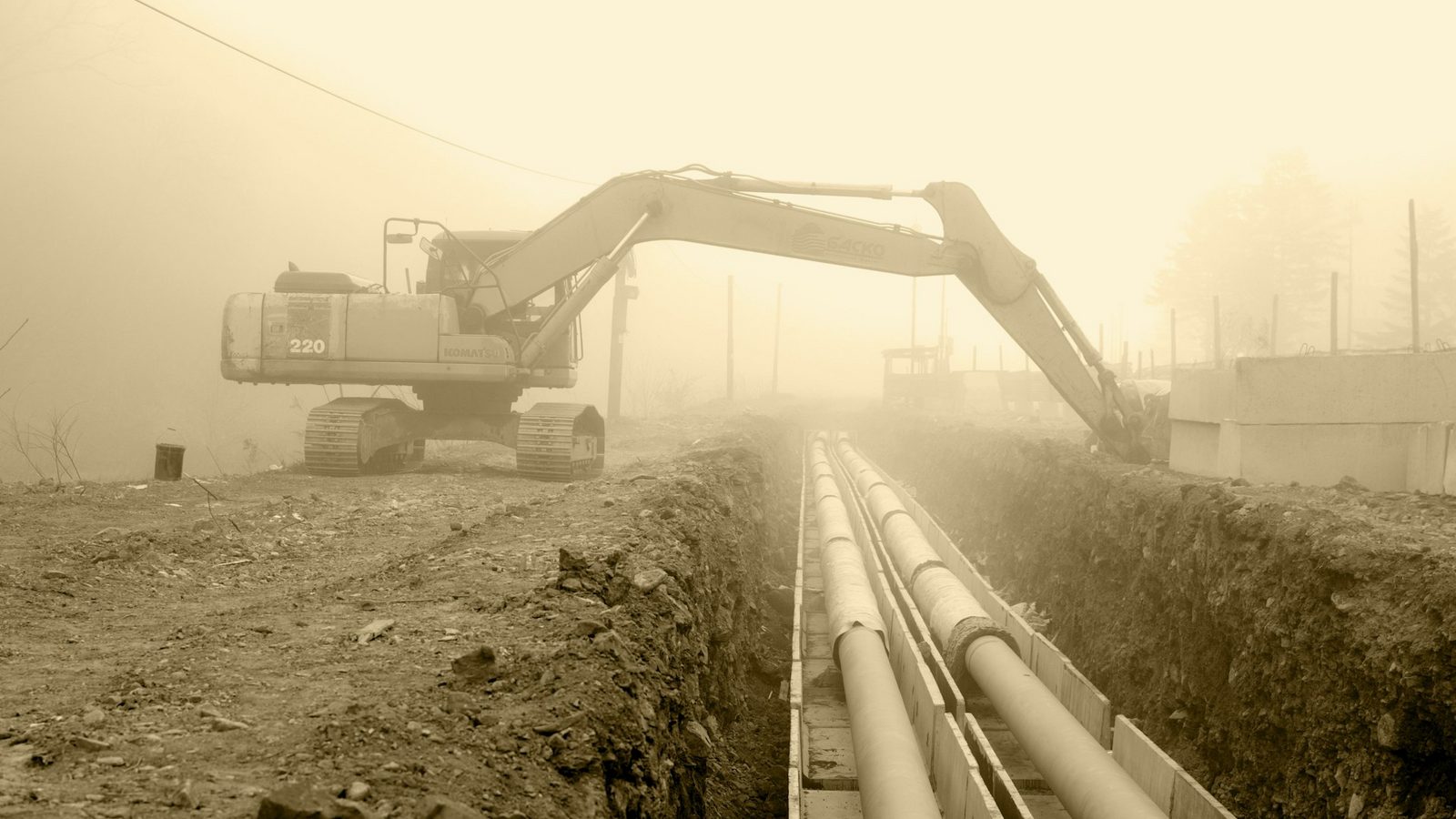
- Excavates a trench from your foundation cleanout out to the connection point at the curb or city main — usually 3–8 feet deep depending on the neighborhood.
- Removes the old pipe entirely.
- Lays new SDR-35 or Schedule-40 PVC pipe with proper slope (typically 1/4 inch per foot for 4-inch line).
- Backfills with crushed stone around the pipe, then native soil.
- Restores the surface — sod, paver re-set, asphalt patch, concrete cut-and-pour.
The honest case for open-trench:
- It works on any pipe condition. Collapsed pipe, fully blocked, misaligned, sloped wrong — none of that matters. You're starting over.
- It corrects slope. Many older Atlantic County homes have bellies (sagging sections) that cause repeated backups. Bellies can't be fixed trenchless. You need a trench.
- It's the cheapest per foot. When the surface restoration is cheap (a grass lawn, an empty side yard), open-trench beats trenchless on cost.
The downside is obvious. Anything on top of the trench has to be removed and rebuilt. That can mean a $4,000 driveway tear-out, $2,000 of replacement landscaping, or a $1,500 paver patio repair. By the time you add it all in, the "cheaper" method often isn't.
How trenchless actually works
Two methods, both well-proven, both legitimate. Don't let anyone tell you trenchless is experimental — CIPP has been used in municipal mains since the 1970s.
Pipe bursting. A bursting head (a torpedo-shaped tool with a flared back end) is pulled through the existing pipe by a hydraulic cable. The head splits the old pipe outward into the surrounding soil, while a new HDPE (high-density polyethylene) pipe is pulled in behind it. You end up with a brand-new, seamless, fused pipe in the same trench the old one occupied — without ever opening a trench. Requires two access pits, typically 4×4 feet each: one at the house and one at the curb.
CIPP lining (cured-in-place pipe). A resin-saturated felt liner is inverted into the existing pipe through a single access point (usually the cleanout). Once it's in position, it's inflated against the inside walls of the old pipe and cured with hot water, steam, or UV light. The result is a smooth, jointless "pipe within a pipe" with a 50–80 year design life.
Both methods avoid most of the surface restoration cost. Both can be done in a single day in most cases. The differences:
- Pipe bursting fully replaces the old pipe with new material. CIPP renews the existing pipe with a liner.
- Pipe bursting can upsize the pipe (4-inch to 6-inch, sometimes). CIPP can't.
- CIPP needs a host pipe that's structurally intact enough to hold the liner. Fully collapsed pipe disqualifies CIPP.
- Pipe bursting can handle some misalignment. Neither method fixes slope.
When trenchless is the right call
Push for trenchless when:
- Your sewer runs under a driveway, sidewalk, or hardscape. The restoration cost of an asphalt or concrete tear-out can easily exceed the premium on trenchless.
- You have mature landscaping you can't replace. A 40-year-old Japanese maple, an established hedge row, an irrigation system — these aren't line items in a restoration quote. They're losses.
- You have a tight schedule. Trenchless is 1 day. Open-trench plus restoration is often a week.
- The pipe is intact but failing from inside. Root intrusion, hairline cracks, scale buildup — these are textbook CIPP cases.
- You're in a flood-prone area. Atlantic City, Brigantine, parts of Margate and Ventnor have high water tables. Open trenches in saturated soil are slower, harder, more expensive, and riskier. Trenchless avoids the trench.
When open-trench is the right call
Push back on trenchless when:
- The pipe is fully collapsed. No host = no liner = no CIPP.
- There's a belly or back-pitch. Slope can only be corrected by a new lay.
- The pipe is offset more than the bursting head can correct. Severe misalignment means open-trench.
- The restoration cost is low. If your sewer runs under a lawn or a side yard with nothing on it, the open-trench premium for restoration is small. Pay the cheaper per-foot rate.
- You need to relocate the line. If the existing run is bad (under an addition, too close to a basement wall), a new lay in a different path is the only option.
Real cost comparison on a South Jersey job
Consider a typical scenario in Pleasantville: 70 feet of cast iron sewer line, 4 feet deep, runs under a paver walkway and a strip of lawn before crossing the driveway to the curb.
Open-trench quote:
- Excavation + new PVC: $7,500
- Permit + inspection: $200
- Pre/post camera: $350
- Walkway tear-out and replacement: $1,800
- Driveway cut and asphalt patch: $2,400
- Sod restoration: $400
- Total: ~$12,650
Trenchless (pipe bursting) quote:
- Two access pits + pipe bursting + new HDPE: $11,200
- Permit + inspection: $200
- Pre/post camera: $350
- Sod restoration at the two pits: $250
- Total: ~$12,000
In this case, trenchless wins by ~$650 — and the homeowner gets their walkway and driveway intact. On a job without the paver walkway and the driveway crossing, open-trench would win by $2,500–$4,000. Numbers shift fast based on what's on top of the line.
Things to ask before you sign anything
Whichever method a contractor recommends, the conversation should include all of these:
- Show me the camera footage. If they haven't run a camera yet, that's the first appointment, not a quote.
- What's the warranty? Reputable trenchless work comes with a 25–50 year material warranty on the pipe and a 5–10 year labor warranty. Open-trench with PVC should match.
- Is the post-job camera in the quote? It should be. Don't pay the final invoice without it.
- What's the slope going to be? Sewer line wants ~1/4 inch per foot. Less and you'll see bellies again. More and solids outrun the water.
- Permit and inspection — included? Always required in Atlantic County. Always.
- Surface restoration scope? Itemized. "We restore the affected area" is not an answer.
- Any allowance for unexpected conditions? Especially for open-trench. Rocks, additional utilities, water table — these can change the job.
What this means for Atlantic County coastal homes
Three local factors shift the decision toward trenchless more than the national average:
- High water table. Open-trench in saturated soil is harder, slower, and more expensive than the textbook quote. We've seen open-trench jobs in Margate balloon by 30% because the trench needed continuous pumping.
- Sandy soil + root intrusion. Sandy soil = roots travel fast. Most of our trenchless work in coastal Atlantic County is responding to root-intruded clay or cast iron — exactly the case CIPP was designed for.
- Older houses with hardscape investments. Pavers, custom driveways, established gardens — coastal home values include the outdoor work. Open-trench wrecks it.
If your home is in inland Atlantic County (Egg Harbor Township, Galloway, Hammonton) with a typical lawn and an accessible side yard, open-trench may still be the right answer. We'll tell you when it is.
Frequently asked questions
Is trenchless really as durable as open-trench replacement? Yes — when it's done correctly on a suitable host pipe. CIPP carries a 50-year design life. Pipe bursting installs new HDPE with a 100-year design life. Both meet or exceed PVC longevity.
How long does the trenchless install actually take? For a standard residential job in Atlantic County: 4–8 hours of on-site work, completing in one day. Open-trench is typically 2–4 days of work plus restoration.
Can trenchless go under a paver driveway or concrete? Yes. That's its strongest use case. You need a small access pit at each end (4×4 feet at the house and another at the city connection or curb), but the actual driveway stays intact.
What about HOA or township restrictions? Atlantic County townships generally permit both methods. A few historic districts and some HOA-controlled communities (parts of Galloway, EHT) have restrictions on excavation that effectively require trenchless. Always check with the construction office before scheduling.
Will trenchless work on roots? Yes — that's one of its best use cases. CIPP lining is specifically effective on root-intruded clay or cast iron. The roots can't penetrate the new liner. We always hydro-jet to clear the existing pipe before lining.
Why do contractors sometimes push open-trench? Two reasons: they don't own the trenchless equipment (it's expensive to buy or rent), or the pipe condition doesn't support trenchless and they're being honest. Get a camera inspection. The camera tells you which one is the truth.
Need a real recommendation for your specific pipe?
Every sewer is different. The right method for your house depends on what the camera shows, what's on top of the line, and what you actually want out of the job. We pull the camera, walk you through the footage, and tell you the honest answer — even when it's the cheaper option.
- Camera inspection across Atlantic County
- Hydro jetting and trenchless services
- Main line drain cleaning
Call 609-308-9600 or send us a message.